
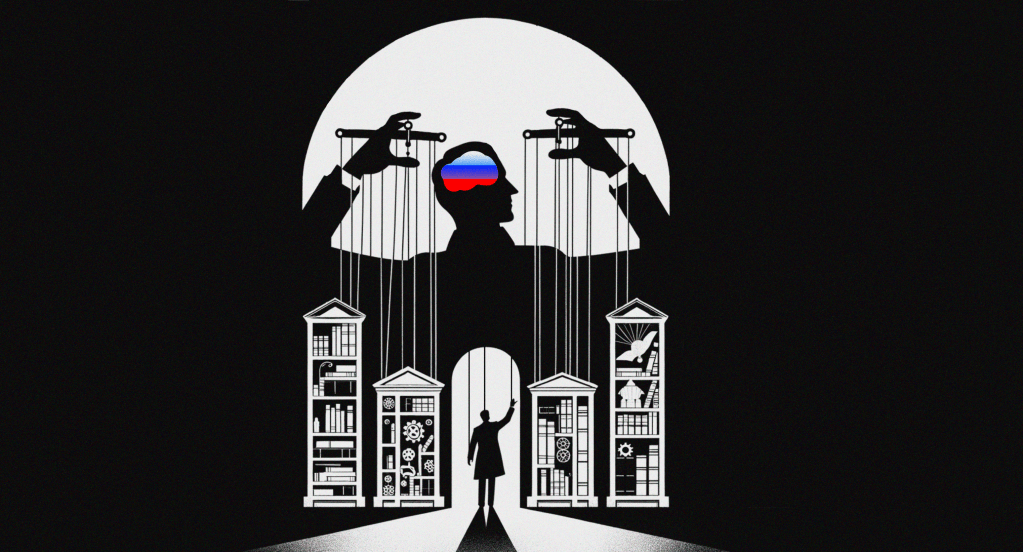
In 2016, I published an article about Russian memory politics and disinformation in the sphere of history, and how Russia systematically suppressed historical narratives inconsistent with Russian propaganda. Back then I argued that these Russian tactics and false historical narratives promote and support military solutions in Ukraine and elsewhere, places where people attempted to deconstruct and demolish Russian imperial narratives and scenarios of development.1 Still, history continues to serve Russian foreign policy, justifying its aggression in Ukraine and elsewhere.
The narratives about the Holodomor as a genocide and more broadly about Soviet violence before and after WWII have become highly problematic for the Russian political leadership, and a number of initiatives have been designed to counterbalance national historical narratives that began to emerge in the former Soviet republics as a result of the archival revolution after 1991.
Since the onset of the Putin era (and this includes the 2001–2002 meetings of Russian historians with Prime Minister Mikhail Kasianov and president Putin in particular), it has become clear that the preferences of the Russian political leadership were to return to “governed history” that would serve the short- and long-term political interests of Putin and his circle. Putin’s “forays” into the realm of history have become routine, and his close ties with the Russian Historical Society (RHS) headed by Sergei Naryshkin and the Russian Military-Historical Society (RMHS) chaired by Vladimir Medinskii are well documented. On 4 November 2022, Putin met the members of the RHS and the RMHS, as well as the representatives of the leading Russian religious communities in the Central Exhibition Hall “Manezh” where they celebrated the Day of People’s Unity in Russia and the opening of the exhibition “Ukraine.” Eight months after Russia’s full-fledged invasion of Ukraine, Putin, designated a war criminal by the International Criminal Court (ICC), and Russian high-ranking officials, sanctioned by the United States and the European Union, ruminated about the objectivity of history and the importance of the appropriation of Ukrainian cultural institutions (i.e. archives and museums) in territories occupied by the Russian Federation.2
Under Putin’s leadership, the Russian government has chosen two approaches to obscuring the truth about Soviet genocides and Russia’s crimes against humanity: legal and clandestine. In this context, for Russians Ukraine has always been a focal point and a point of departure in any historical discussion. The goals of these two approaches include:
 AIHPS
AIHPS 